C-CoMP Sessions at ASLO27
We are excited to announce that C-CoMP members are leading four separate sessions at the ASLO 2027 Aquatic Sciences Meeting in San Juan, Puerto Rico. If you are interested in submitting an abstract to one of our sessions, please read through the session titles and descriptions posted below. Session descriptions are also available on the official ASLO27 website on their ‘Session List’ webpage have listed the session information below.
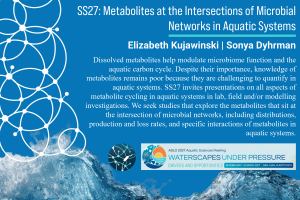
SS27: Metabolites at the Intersections of Microbial Networks in Aquatic Systems
Elizabeth Kujawinski, WHOI (ekujawinski@whoi.edu)
Sonya Dyhrman, Columbia University (sdyhrman@ldeo.columbia.edu)
Metabolites are organic molecules produced during biochemical reactions within organisms across all taxonomic levels in aquatic systems. Once dissolved in the surrounding water, they serve as growth substrates, co-factors and/or infochemical signals within microbial consortia, thus playing important roles in modulating microbiome function. Despite the central role of the chemical-microbe network in the aquatic carbon cycle, our knowledge of metabolites and their dynamics in various aquatic systems remains poor because metabolites are analytically challenging to quantify in aquatic systems due to their heterogeneous chemical nature and their dilute concentrations relative to background organic matter. This session invites presentations on all aspects of metabolite cycling in aquatic systems in laboratory, field and/or modelling investigations. We seek studies that explore the metabolites that sit at the intersection of microbial networks, including distributions, production and loss rates, and specific interactions of metabolites in aquatic systems. These can include chemical, biological, and numerical investigations in both laboratory and field contexts. Novel analytical methods that expand the lexicon of metabolites are welcome, as well as new computational and modelling efforts that integrate across complementary ‘omics datasets to gain insights into the function of the chemical-microbe network.
Keywords: microbe-metabolite networks, biogeochemical modelling, metabolites, DOM
SS35:Modeling Across Scales in Aquatic Ecosystems
Arianna Krinos, Brown University (akrinos@whoi.edu)
Mara Freilich, Brown University (mara_freilich@brown.edu)
Suzana Leles, University of Texas at Austin (suzana.leles@utexas.edu)
Aquatic environments are inherently multiscale–physically, biologically, and chemically. Broad understanding of aquatic ecosystems requires systems-level synthesis of transport and biogeochemistry. Multiscale analysis underlies predictive capacity in the field: processes at small scales, e.g., the Kolmogorov or the single-cell level have been shown to be predictive of larger scales, e.g., pollutant dispersal and physiological stress. Aquatic modeling frameworks at the whole-ocean or whole-water column scale have been extensively leveraged to make predictions about the future physical, chemical, and biological states of aquatic environments. However, increasingly, smaller-scale models (e.g., kilometer and smaller scale physical circulation models), physiological models (e.g., proteome allocation models and macromolecular models), and genome-scale metabolic models are used to explain local trends and the extensive information available in molecular -omics data (including genomics, transcriptomics, proteomics, and metabolomics). Unifying scales of modeling can lead to powerful insights of how small-scale processes map to large-scale predictions useful over longer timescales. In this session, we invite modeling work that includes or considers multiple scales. This may take the form of multiple models coupled together, or creative ways of evaluating cross-scale results. We particularly invite proposals considering the importance of interactions between small-scale physical, biological, or chemical processes over larger temporal or spatial scales.
Keywords: modeling, `-omics, multiscale, dynamics
EP07: What Works in Research Training
Erin Dolan, University of Georgia (eldolan@uga.edu)
Victoria Centurino, Woods Hole Oceanographic Institute (victoria.centurino@whoi.edu)
Students often engage in research at the undergraduate and graduate level to prepare for and pursue careers in the ocean sciences. A growing body of research on undergraduate and graduate research is revealing “what works” in research training, including how research can be structured to promote various outcomes. This includes having opportunities to try research as a potential career path, develop research knowledge and skills, build an identity as a researcher, and confirm educational and career pursuits. This session will feature presentations on course-based undergraduate research experiences to scale up access to research; postbaccalaureate research education to gain additional research experience and prepare for graduate education; and interventions to promote effective mentoring and wellbeing of graduate students.
Keywords: research training, mentorship, student wellbeing, course-based undergraduate research experiences
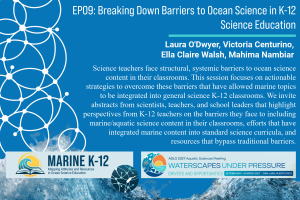
EP09: Breaking Down Barriers to Ocean Science in K-12 Science Education
Laura O’Dwyer, Boston College (odwyerl@bc.edu)
Victoria Centurino, Woods Hole Oceanographic Institution (victoria.centurino@whoi.edu)
Ella Claire Walsh, Boston College (walshahj@bc.edu)
Mahima Nambiar, Boston College (nambiarm@bc.edu)
Science teachers face systemic barriers to including non-terrestrial based science content in their classrooms. These barriers are structural: an already crowded curriculum, marine based content not being present in textbooks or state science standards, and a lack of training in teaching ocean science content. However, the ocean is not a supplementary topic. It is a topic that offers a unique opportunity to teach foundational concepts in general biology, chemistry, and the earth sciences through interdisciplinary connections. To correct this educational deficit, we must focus on opportunities that allow teachers to correct these barriers. This session focuses on actionable strategies to overcome these barriers that have allowed marine topics to be integrated into general science K-12 classrooms. We are specifically interested in identifying what works when attempting to bridge gaps between scientific researchers and classroom teachers. We invite abstracts from scientists, teachers, and school leaders that highlight perspectives from K-12 teachers on the barriers they face to including marine/aquatic science content in their classrooms, efforts that have integrated marine content into standard science curricula, and resources that bypass traditional barriers. We seek to prioritize work that highlights the empowerment of educators to teach critical ocean science content while maintaining mandated coverage of other topics.
Keywords: K-12 Ocean Science Education, Ocean Literacy, Interdisciplinary science, Scientist-educator collaborations