Microbes at COP 30

Advocating for the Invisible Microbial Majority That Underpins a Healthy Planet Panel
November 19th, 2025
PV-D120
1:30 - 2:30 pm (BRT)
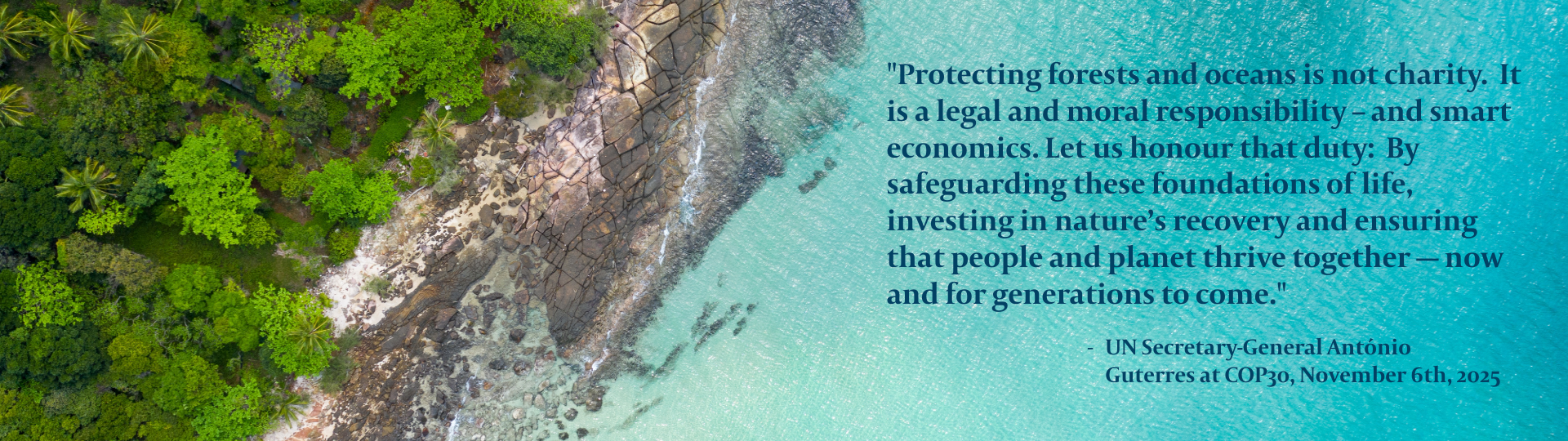
Drawing inspiration from the the UN General Secretary, at the heart of all ecosystems on Earth is an invisible network of micro-organisms that support food webs and underpin the ecosystem services upon which we and our planet depend. Microbes inhabit all parts of the planet – from the land to the ocean, they recycle nutrients, fuel roughly half of global carbon fixation through photosynthesis, while supporting the ecosystem services provided by healthy forests, abundant fisheries, and sustainable coral reefs. How do we advocate for this unseen majority? From the land to the sea this invisible world is both a player and a stakeholder in what happens next for our planet. Join us as we highlight the latest science, and discuss how to include this invisible planetary network in a sustainable future. We can’t ignore this invisible world… we are looking for thought partners on how to advocate for this unseen majority.
To help advocate for microbes this week and beyond, please consider how microbes are players and stakeholders in climate and attend the "Advocating for the Invisible Microbial Majority That Underpins a Healthy Planet" panel discussion on November 19th from 1:30 - 2:30 pm (BRT, COP30 Ocean Pavilion Website).
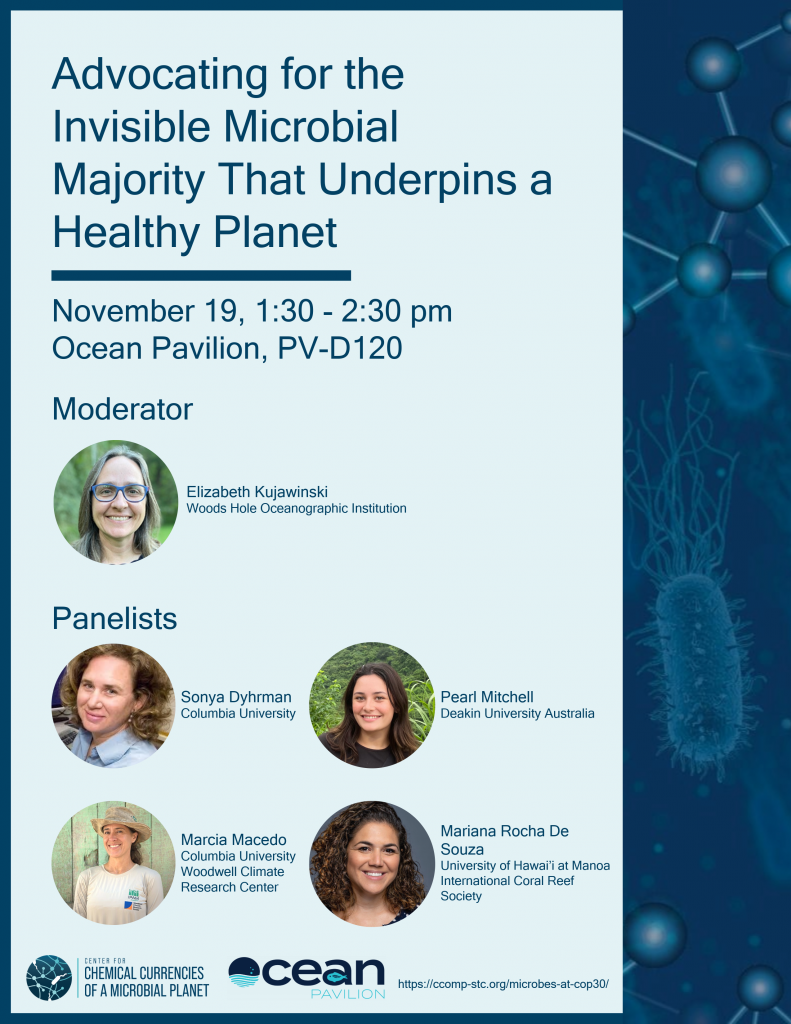
Panel hosts
Elizabeth Kujawinski
Director of C-CoMP
Senior Scientist at WHOI
Website
Sonya Dyhrman
C-CoMP Executive Committee
Professor at Columbia University
Website
Additional Reading and Resources
- American Academy of Microbiology Climate Change and Microbes Scientific Portfolio, created to enhance understanding of climate change and microbes, inform policy, and drive market innovations
- BioGeoSCAPES, an International Community formed to improve understanding of the ocean microbial biogeochemistry
- National Academies of Sciences, Engineering, and Medicine. (2021). A research strategy for ocean-based carbon dioxide removal and sequestration.
- Moran, M. A., Kujawinski, E. B., Schroer, W. F., Amin, S. A., Bates, N. R., Bertrand, E. M., Braakman, R., Brown, C. T., Covert, M. W., Doney, S. C., Dyhrman, S. T., Edison, A. S., Eren, A. M., Levine, N. M., Li, L., Ross, A. C., Saito, M. A., Santoro, A. E., Segré, D., Shade, A., Sullivan, M. B., & Vardi, A. (2022). Microbial metabolites in the marine carbon cycle. Nature Microbiology, 7(4), 508-523. doi: https://doi.org/10.1038/s41564-022-01090-3. Read-only version. Pre-print version.
- Peixoto, R., Voolstra, C. R., Stein, L. Y., Hugenholtz, P., Falcao Salles, J., Amin, S. A., ... & Gilbert, J. A. (2024). Microbial solutions must be deployed against climate catastrophe. FEMS microbiology ecology, 100(11), fiae144.
- Virtual Ocean Pavilion
About C-CoMP
The Center for Chemical Currencies of a Microbial Planet (C-CoMP) is a U.S. National Science Funded Science and Technology Center based at Woods Hole Oceanographic Institution. C-CoMP is also a United Nations Ocean Decade Contribution.
C-CoMP's mission is to leverage recent advances in analytical and data sciences, incorporates new ocean sampling technologies and an open-science framework, and engage scientists, educators, and policy-makers who bring a variety of expertise, experiences, and viewpoints to bear on promoting a deeper understanding and appreciation of the chemicals and microbial processes that underpin ocean ecosystems and other microbiomes that affect our daily life.
To learn more about C-CoMP, please visit our Mission and More webpage, research webpage, publications list, and data lists.